
Jewellery valuations & appraisals · Melbourne CBD
At Jewellery Valuations Australia, we provide unbiased, expert and thoughtful appraisals for your most treasured jewellery and timepieces.
A valuation is more than just a number.
Behind every figure on a JVA certificate is a considered judgement — the piece examined in the hand, the stones assessed, the workmanship weighed, the current market understood. That number is what your insurer relies on, what a court accepts, and what protects you if a piece is ever lost, damaged or disputed.
But it is also something more: a detailed record of a physical memory. Jewellery holds the moments it was given for — and a valuation preserves the details of the piece itself, so that what it is, and what it means, is never lost.
We treat every item as irreplaceable, because to you it is. Each valuation is carried out with the same care, precision and discretion, then documented to protect and preserve the piece for years to come.
Not just a number. A record you can trust.
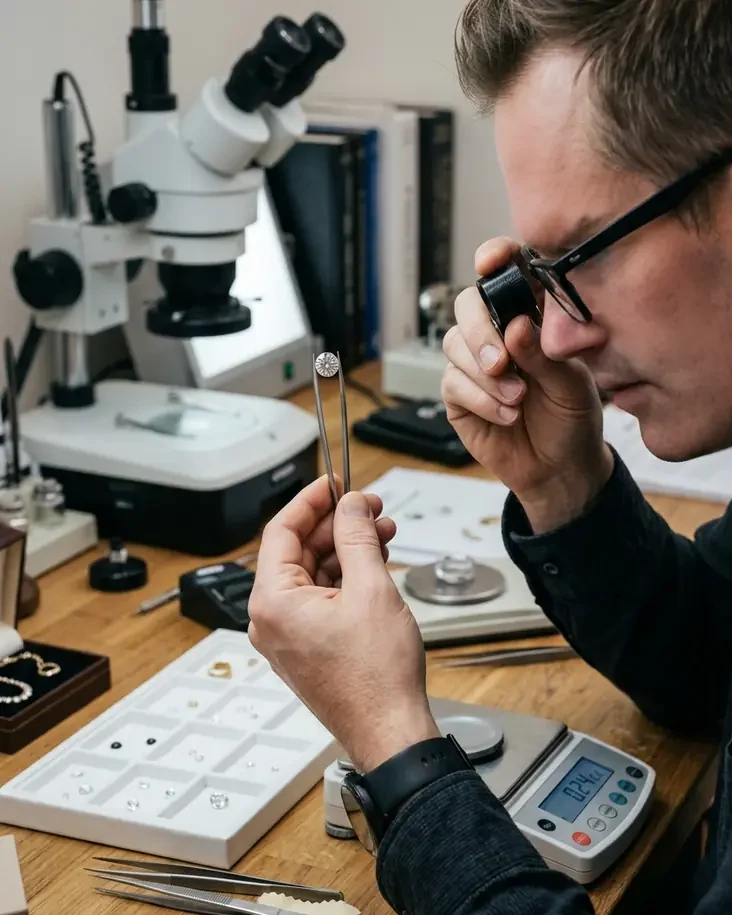
Located in the heart of the Melbourne CBD, we service wholesale and private clients alike, taking the time to test each piece and meticulously assess it with the care it deserves. Our work covers jewellery valuations and appraisals, diamond valuations, gold valuations and watch valuations, from a single ring to an entire jewellery collection.
Whether you're looking for a valuation for insurance purposes or need an estate valuation, our founder Marek Diug — a registered jewellery valuer with the Australian Association of Jewellery Valuers (AAJV) — and his passionate team are here to guide you through the process in our safe and secure laboratory space.

Marek Diug
With over 20 years in the field, Marek is a Gemological Institute of America (GIA) graduate and a registered jewellery valuer with the Australian Association of Jewellery Valuers (AAJV). His family's deep roots in the industry inform every assessment he makes.
Beyond diamond valuations and coloured stones, our laboratory is equipped for gold valuations and watch valuations, identifying metal composition with precision.
What our clients say
“Very professional setup. Prompt and expert service. Great for both trade and public. Lovely staff — pleasure to deal with.”Kaja G.Google review
“Can't be happier with the staff and service. A+”Jordan S.Google review
“My experience with Jewellery Valuations Australia was a really positive one. Service was great; really prompt, professional and thorough! Would highly recommend and would use them again!”Simone I.Google review
Services
We provide three core valuation services, each appraisal carried out with the same rigour and care.
Insurance valuations
Certificates required by insurance companies to insure your jewellery. Each certificate includes metal weight, diamond and stone details, a photograph, and a current retail replacement value.
Generally valid for two to three years — we recommend checking with your insurer for their specific renewal requirements.
Estate & divorce valuations
Certificates required to establish a fair second-hand or liquidation price, used to help divide assets in estates and divorce settlements.
Each certificate includes metal weight, diamond and stone details, a photograph, and a fair liquidation value.
Superannuation fund valuations
Valuations for jewellery held as an asset of a self-managed super fund, prepared for the fund's annual reporting and audit.
Each certificate documents the item in full, with its market value as at the date of assessment.
Completion time
We offer same-day valuations for up to three basic items dropped off before 12pm, ready for collection the same day between 2pm and 5pm. Larger or more intricate pieces, or items received after midday, will be given an estimated completion time at drop-off — you're welcome to collect any time after that.
What is a jewellery insurance valuation?
An insurance valuation is a formal written assessment of what it would cost to replace a piece of jewellery with one of equivalent quality, at current retail prices in Australia. It records the piece in detail — metal type and weight, gemstone identification, dimensions, cut, clarity and colour grading, setting style and any hallmarks — alongside photographs and a replacement figure.
It is not a resale or trade-in price, and it is not what a buyer would pay for the piece second-hand. It is the sum your insurer would need to cover to have the item remade or replaced.
Why insurers ask for one
Most Australian home and contents policies limit cover on unspecified jewellery to a modest per-item amount — often between $1,000 and $2,500. Anything above that threshold usually has to be listed individually, and insurers generally require a current valuation from a qualified valuer before they will specify an item.
Without one, a claim can be settled on the insurer's own estimate rather than the true replacement cost, which frequently falls short. A valuation certificate removes that ambiguity: it establishes what the piece is, that you owned it, and what it is worth, before anything goes wrong.
Engagement & wedding rings
The most commonly claimed items of jewellery, and the most commonly under-insured. Diamond prices move, and a ring valued a decade ago is unlikely to reflect today's replacement cost.
Inherited & antique pieces
Often never formally assessed. Age, provenance and period craftsmanship can carry significant value beyond the metal and stones alone.
Watches
Luxury timepieces can appreciate sharply and unevenly. Reference number, condition, and whether box and papers survive all affect replacement cost.
Coloured gemstones
Value depends heavily on origin and treatment, both of which require laboratory testing to establish. Two similar-looking sapphires can differ many times over in worth.
Gold bullion & Indian jewellery
Bars, ingots and cast pieces, along with solid 22kt and 24kt gold bangles, chains and traditional Indian jewellery. Each piece is tested and weighed in our laboratory to confirm purity and content, with weight and fineness recorded on the certificate.
Coins
Gold and silver coins, held individually or as a collection. Coins sealed in original packaging are not opened — the packaging forms part of the value.
Superannuation fund valuations
We also value jewellery held as an asset of a superannuation fund. Where a piece is allocated to a self-managed super fund, the fund needs a written record of what it is worth for its annual reporting and audit.
Our valuation documents the item in full — metal, gemstones, measurements and condition — along with its market value as at the date of assessment. Your fund's accountant or auditor can confirm how often they require it to be updated.
How often should a valuation be updated?
Most insurers ask for a valuation no more than two to three years old. Precious metal and diamond prices shift, and an out-of-date certificate can leave a piece significantly under-insured without the owner realising. We recommend reviewing your valuations every two to three years, or sooner after any notable movement in gold prices.
Updating an existing valuation is usually faster and less involved than the original assessment, particularly where we hold the original record.
Please note: update requirements vary between insurers and between policies. The guidance above is general only — always check with your own insurance company for the valuation currency they require.
What you receive
Every insurance valuation we issue includes a full written description of the piece, gemstone identification and grading, professional photography, and a replacement value in Australian dollars, presented as a certificate suitable for submission to your insurer. Your record is retained by us, so future updates and replacement copies are straightforward.
Ready to have a piece valued?
Give us a call and we'll talk through what you have and what your insurer needs.
Process & Tools
Here's what to expect from first call to final collection — so nothing comes as a surprise.
Tools & specialist equipment
During the valuation process, your piece undergoes a series of tests using industry-leading technology. Jewellery, gemstones and timepieces aren't always as they first appear — combining expert eyes with advanced equipment lets us determine metal composition, differentiate between natural, synthetic and lab-grown stones, and authenticate watches.
X-Ray Fluorescence (XRF) machine
Our top of the range XRF machine identifies metal composition — whether a piece is gold (and its fineness), silver, base metals like zinc and copper, and more. Especially useful when a piece is unstamped, or its stamp has worn away.
Lab-grown diamond & simulant detector
Measures a stone's reaction to UV light to distinguish natural diamonds from their synthetic and lab-grown counterparts — an essential step given the difference in value between the two.
Refractometer
Measures a gemstone's refractive index. Different gemstones bend and split light differently — identifying that index is key to identifying the stone itself.
Loupe & microscope
Magnification lets our valuer examine cut, clarity and craftsmanship up close — spotting inclusions, wear, and repairs invisible to the naked eye.
Electronic scales
Precise metal and stone weights, measured to the hundredth of a gram, form the basis of every valuation figure.
Gemstone testing kit
A set of specialist probes and reagents used alongside our other instruments to confirm a stone's identity where results need cross-checking.
Meet the team
Our team brings together more than 50 years of combined experience in the jewellery industry. Every valuation is carried out by someone who has spent a career learning to see what others miss — trained, tested and trusted.
Each of us came to this work through a genuine appreciation of jewellery — the craftsmanship in a setting, the history in a hallmark, and the story a client carries in with the piece.
Anna
A former graphic designer, Anna talks clients through their pieces with clarity and care.
Steph
Keeps the valuations process running smoothly. A particular love of watches and historic hallmarks.
Katya
Welcoming clients and preparing everything the valuations team needs.
Jane
Broad, practical knowledge of the trade, with a particular enthusiasm for coloured gemstones.
Ashley
Fascinated by craftsmanship and how jewellery techniques have been refined over history.
Location
Our laboratory is in the heart of Melbourne. If you can't come to us, you can also submit a piece through one of our trusted partner jewellers.
Home & on-site visits
If you have a large collection that can't be easily transported to us, you may be able to arrange an on-site visit, where our valuer comes to you to assess and value your pieces directly. Some items may still need to be brought into the laboratory for further testing. Turnaround time will depend on the size and detail of your collection.
Important information
A few things worth knowing before your visit.
Pricing
Every piece is different, so the final fee is confirmed at your drop-off appointment once a valuer has seen the item. The figures below are our starting rates.
All prices in Australian dollars and include GST. Payment is due on collection.